
Key Collection
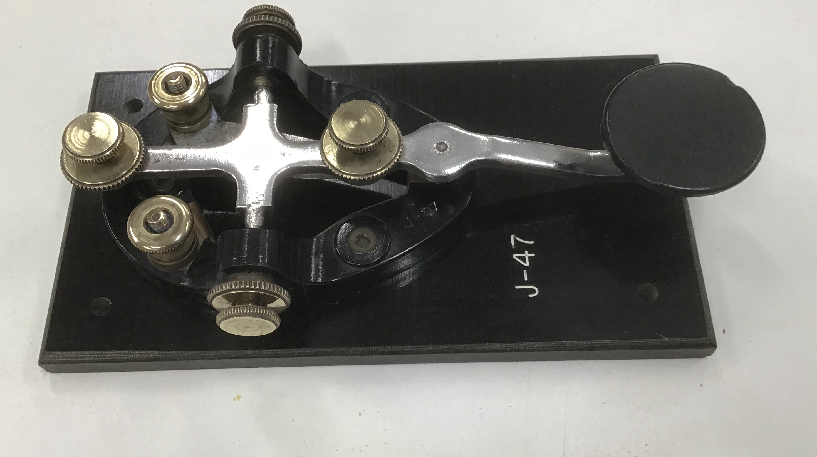
Date: 2025-01-13One of the few pieces of equipment I retained from my 1970s is this war surplus key. This style of CW key is known as a straight key. It is a simple on-off switch that is connected to the transmitter.
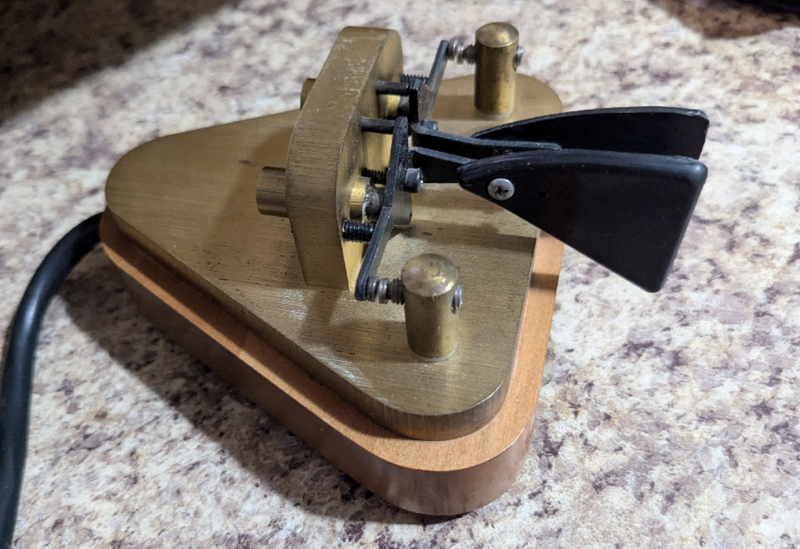
When I enrolled in CW Academy, they required that I learn to send with a two paddle key, and I acquired this well-used "Brass Racer" made by Vibroplex. This style of key, when connected to a modern transceiver with an integrated keyer, will send a continuous string of dits when the left contacts are closed, and a continuous series of dahs when the right contacts are closed. I appreciate the concept, as it promotes more self-consistent character sending. This style of key also requires fewer motions to send code, and it is easier on my old wrist.
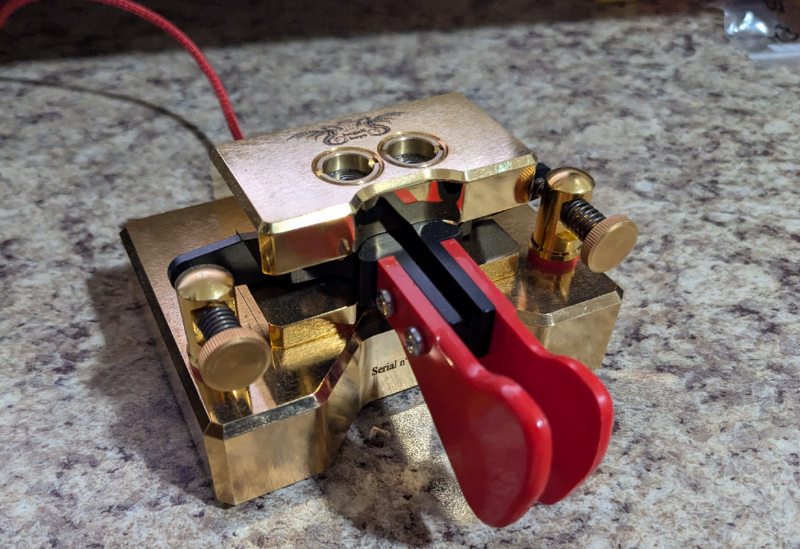
Subsequently I upgraded to this Begali key, which has superior engineering and precision. I think it's pretty and cool, and it has improved my sending.
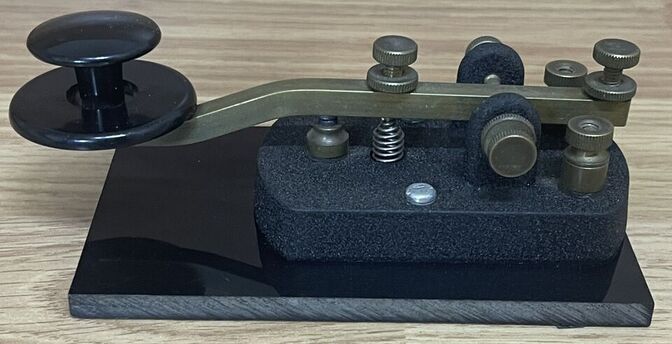
In January 2025, I purchased this straight key on eBay.
The seller describes it as: Nye Viking H15.681 made of Brass and steel black covered base with a navy knob mounted to a black plastic Base all in excellent condition. Internet searching suggests that this is a key made in the 1970s or 1980s.
The key is also referred to as Speed-x . Apparently the Nye company is a successor manufacturer of Speed-x keys. An earlier manufacturer was E.F. Johnson. More...
To expand my skillset, and to provide an optional means of participation in SKCC, I bought a bug. This is the Vibroplex "Original" made in 1956
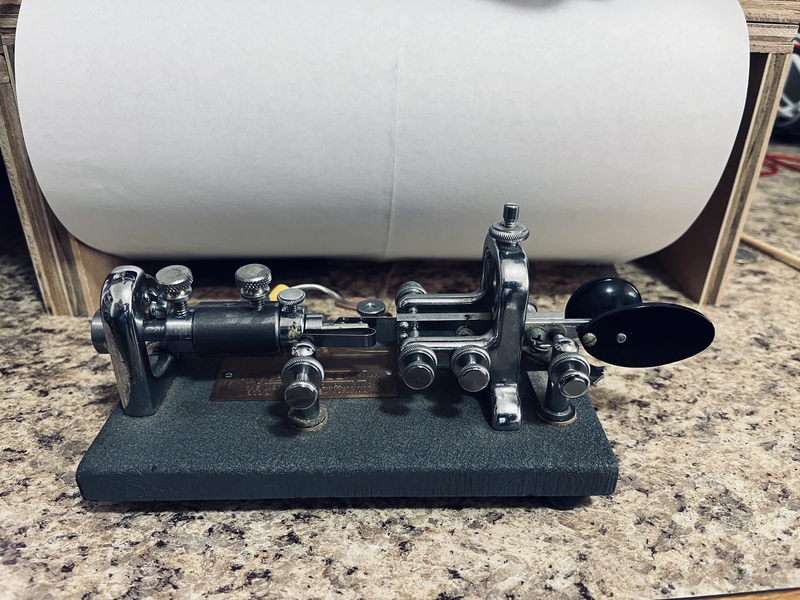
I machined some extreme weights for it, and with the extra weight, the key slows down to 17 words per minute.
I'm not yet comfortable with it, but here it is in action:
In the fall of 2025, I acquired a sideswiper key made by KN4YB. The sideswiper was introduced in the early days of telegraphy as an instrument that would reduce tendon stress for operators. In design, it is basically two straight keys laid on their side. Operating the sideswiper (also known as a cootie) is a skill all of its own. I've grown to like this mechanical key.
Here it is in action:
Comments
I welcome your comments. You do NOT need to sign in to leave a comment. If you create an account and sign in, my comment system will notify you of replies to your comment. Thanks for stopping by.--Duane McGuire